 Aliaro
How to split household chores fairly (as a couple, with kids or with roommates)
"I always do the dishes." "Well, I take out the trash." Arguments about chores are almost never about the dishes: they're about feeling the split isn't fair. The good news is you can fix it with a clear, visible system.
Step 1: list every chore
Sit down for 20 minutes and write down every household task, including the invisible ones: booking the pediatrician, remembering birthdays, checking what's missing in the fridge. Next to each one, its frequency:
- Daily: cooking, dishes, tidying up, laundry.
- Weekly: vacuuming, bathrooms, changing sheets, the big grocery shop.
- Monthly or occasional: cleaning the fridge and oven, windows, paperwork.
Just seeing the full list, many couples spot the imbalance without needing to argue about it.
Three ways to split chores
By preference
Everyone picks the chores they mind least, and the rest gets shared out. Works really well for couples: whoever likes cooking cooks, and the other does the dishes and the shopping.
By rotation
The heavy chores (bathrooms, deep-cleaning the kitchen) rotate every week. It's the fairest system when nobody wants certain tasks, and the most common one with roommates.
By time
Instead of counting chores, count time. Ten minutes taking out the trash isn't the same as an hour cleaning the bathroom. Useful when people's schedules are very different.
Whatever method you choose, what works is making the split visible to everyone and being able to see who did what. What isn't seen isn't valued.
Age-appropriate chores for kids
| Age | Chores they can do |
|---|---|
| 3–5 | Pick up toys, put clothes in the hamper, set out napkins |
| 6–8 | Set and clear the table, make their bed, feed the pet |
| 9–12 | Vacuum their room, hang laundry, help cook, take out the trash |
| 13+ | Cook simple meals, run the washing machine, clean the bathroom |
It works best when each child has their own chores assigned and can mark them as done. Seeing their progress motivates them more than any reminder.
If you live with roommates
- Separate shared areas (kitchen, bathroom, living room) from personal ones.
- Rotate the shared areas weekly.
- Agree on a minimum standard: "clean" doesn't mean the same thing to everyone.
- Keep the rota where everyone can see it, not in one person's head.
How to make it last
- Review the split every month. Schedules, jobs and school terms change.
- No supervisors. If one person has to remind everyone else of their chores, they're still carrying the mental load.
- Acknowledge what gets done. A history of who did what ends the "I do more than you" argument.
How Aliaro does it
In Aliaro you assign chores to each family member and everyone can see who has what:
- Chores assigned per person
- History of who did what and when
- Reminders for each person
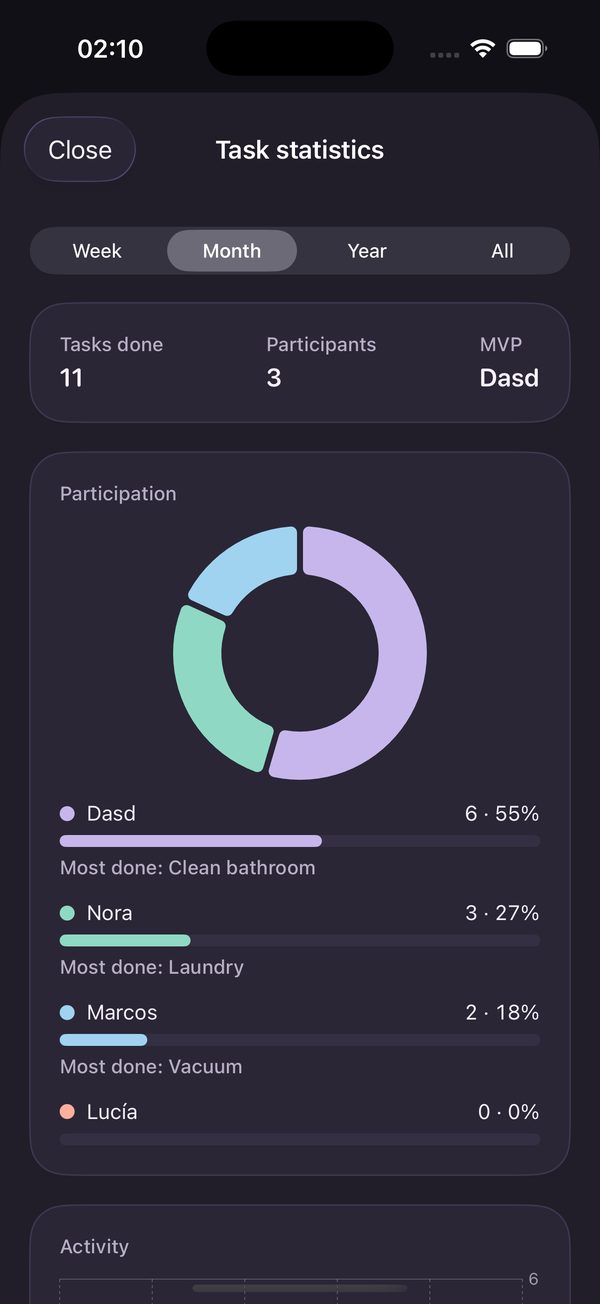
- Participation stats (Premium)